Reasons retailers choose Tower Systems
R

The POS Software Blog
News from Tower Systems about locally made POS software for specialty local retailers.
Gift shops come and go. Walk down most shopping strips in Australia or New Zealand and you’ll see it. A new shop opens with a fresh fit-out and a lot of hope. Another closes. A third changes hands, sometimes more than once in a few years.
There are plenty of reasons. Rent, staffing, the wrong mix of stock, an owner who is simply worn out. But we see a pattern in the gift shops that last. They’re consistent. They buy well, they know what’s selling, and the owner isn’t buried in admin every night.
That consistency is bankable. It’s what keeps a shop profitable through a slow winter, and it’s what a buyer pays for when the time comes to sell. Good software won’t do the work for you. It can make that consistency a lot easier to achieve.
A gift shop can carry hundreds of different products from dozens of suppliers. Every delivery brings paperwork. Keying it in by hand is slow, and it’s where mistakes creep in.
Tower Systems imports supplier invoices for you, with AI tools that handle most formats. Product data loads when you scan a new item, so the description and category are there without typing. Some of our customers tell us the AI tools save them hours every week.
Hampers and gift packs are another time sink in a lot of shops. Our software treats a hamper as one product made from its parts. Sell it, and the candle, the chocolate and the card all come out of stock at once. You know what you have without counting.
If you sell online, your Shopify, WooCommerce, Magento or BigCommerce store stays in step with the shop. Sell an item at the counter and the website knows. Click and collect orders are managed in the same system. Gift cards, special orders and club or group pricing are covered too.
Saving time is half of it. The other half is making better calls about stock, pricing and space.
Gift retail is seasonal. Tower Systems tracks which products sell in the lead-up to Mother’s Day, Christmas and other key periods, so next year’s order is based on what actually sold rather than a hunch. The embedded AI tools surface insights you’d otherwise find weeks or months later, if at all. Things like a supplier whose range has quietly stopped moving, or a category that deserves more shelf space.
Loyalty works the same way. Instead of a points scheme customers forget about, you can print a voucher on the receipt that brings them back within a set time. You can record special dates and preferences too, so your team can offer the personal service that sets a local gift shop apart.
None of this replaces the owner’s eye for product. It backs it up with facts, and over time that’s what steers a shop toward steady profit.
Staying the course also means having people you can rely on. Our help desk is based in Australia and New Zealand, and it’s open on Saturdays when gift shops are busiest. You talk to a person, not a script. You also choose when to install software updates, so nothing changes at the counter in the middle of December.
The cost should be predictable too. Some software companies take a percentage of every sale. We don’t. You pick your own EFTPOS provider and keep control of what you pay.
If you’re opening a gift shop, buying one or looking to strengthen the one you have, we’d like to show you how Tower Systems could help. Already on other software? Send us your data first and we’ll confirm whether it can be brought across.
You can read more about Tower Systems for gift shops, call 1300 662 957 (0800 444 367 in New Zealand) or email sales@towersystems.com.au.
Contacting a human is easy.
Ask a pet owner where they get advice and plenty will name their local pet shop. Not a big-box store. Not a website.
That’s because the local shop knows them. It knows the family down the road has a new puppy that isn’t settling on its food. It knows which customer keeps a bearded dragon and what the enclosure needs. It remembers when the dog is due for worming.
Big pet businesses sell a lot of product. We’d argue local pet shops matter more to local pets. And we think they deserve software built for the way they work, not a generic system they have to work around.
Think about a normal day. Birdseed sold by the kilo. A collar in a particular size and colour. A live fish. A dog in for a groom. A conversation about changing a cat’s diet.
Most POS software handles the barcode scan at the counter and not much else. The rest ends up on paper, or in the owner’s head.
We built Tower Systems for pet shops to deal with all of it. Bulk food and treats sell by weight, in whole or part quantities. Collars, apparel and bedding are tracked by colour, size and style. You can record the history and care of live animals, and track high-value items by serial number.
The customer side is where a local shop really wins. You can record microchip numbers. You can recall customers when worming, or a similar product, is due. You can print care notes on the receipt, like how to move a puppy onto a new food. And you can market to people based on what they’ve actually bought, so your offers make sense to them.
Promotions work the way a local shop needs them to. Buy-one-get-one deals. Coffee-card style loyalty. Bundles too, such as a tank, filter and starter food at one price. Bundles lift the spend per visit, and they’re harder to price-check item by item online.
If you run a grooming salon or a DIY dog wash, you can track that work in the same system as your retail sales and let owners know when their pet is ready to collect. Repairs and servicing are tracked at no extra cost, whether it’s an aquarium pump or a set of clippers that needs sharpening. Recurring billing is there if you need it.
Then there’s the admin. Supplier invoices import automatically. The built-in AI tools write product descriptions for your online store and help you make sense of your reports. The software connects with Shopify, WooCommerce, Magento and BigCommerce, plus Xero, Tanda and Deputy. You pick your own EFTPOS provider, and we don’t take a cut of your sales.
Our help desk is in Australia and New Zealand. When you call, you get a person who knows independent retail, not someone reading a script.
You also decide when to install updates. We release them regularly, often with improvements customers asked for, but they go in when it suits you. Not in the middle of a busy Saturday.
If you run an independent pet shop, we’d like to show you how it works. Bring your own situations to a demo: a bulk food sale, a grooming job, a worming reminder. If you’re switching from other software, send us your data first and we’ll confirm whether we can bring it across.
You can read more about Tower Systems for pet shops, call 1300 662 957 (0800 444 367 in New Zealand) or email sales@towersystems.com.au.
Contacting a human is easy.
A stockfeed, produce or farm supply business manages bulk stock, organise deliveries, prepare feed mixes, look after customer accounts and source products customers cannot find on your shelves. All at once.
Tower Systems brings these jobs together in specialist software. Locally made and supported, it helps connect your counter, stockroom, delivery vehicles and online shop.
Deliveries are a core part of many farm supply businesses. Your software needs to help manage the work from the initial order through to dispatch.
Tower Systems includes dispatch management for multiple trucks and multiple deliveries per vehicle. Integration with Allotrac provides an option for businesses with more advanced delivery requirements.
When selling from a bulk supply tanker or truck, you need to charge farmers for what you actually provide. Support for weight-based and fractional quantities helps you handle these sales accurately.
Retailer Roam™ also supports selling away from the shop, including from a truck. It can operate without an internet connection, helping you serve customers beyond reliable mobile coverage.
Your own feed mixes can give customers a reason to choose your business.
Tower Systems supports buying raw materials and managing their mixing or packaging into finished products. This helps you connect the ingredients you purchase with the products you prepare and sell.
Buy in bulk, mix to your recipe and charge accurately for the finished product. Whether customers buy a standard bag or a specific quantity, your software should support the way you trade.
Strong general debtors facilities are important when account customers represent a substantial part of your business.
Tower Systems combines customer account management with quote and invoice management tools. You can prepare quotes, manage invoices and keep track of what customers owe within the same system you use to run the shop.
That matters when a customer’s purchase involves more than a quick counter transaction. A quoted order, a scheduled delivery and an account sale are connected parts of the same customer relationship.
Loyalty options provide another way to recognise repeat business. Choose an approach that farmers value and that makes commercial sense for your store.
You cannot carry every product every customer might need. You can, however, make special orders part of your service.
Tower Systems supports bringing in and managing special orders for customers. This helps you look beyond the stock on your shelves when responding to a request.
For an independent farm supply business, that is an opportunity to compete through service. You can help customers source what they need while keeping the order organised within your retail software.
Spend less time entering supplier invoices
Supplier paperwork can consume time that would be better spent serving customers or managing the business.
Tower Systems includes AI tools for importing just about any supplier invoice. These tools help reduce manual data entry and the work involved in bringing supplier invoice information into your system.
An integrated barcode lookup tool provides access to 1.6 billion barcodes, helping you find product information without starting every product record from scratch.
Together, these tools target everyday administration that can otherwise slow your team down.
Online selling should be part of your business, not a separate stock-management task.
Tower Systems integrates with Shopify, synchronising product descriptions, pricing and images. Online sales flow back into the software to help keep inventory accurate.
This gives customers another way to buy while connecting online activity with your existing retail operation.
You should not have to find spare time to assemble reports before you can understand how your business is performing.
The Tower Systems Insights Dashboard provides business performance insights around the clock, without you having to prepare them manually.
It gives you a way to check performance when it suits you, rather than adding another reporting job to your day.
Choose local support and a voice in future development
Software is a long-term business relationship. The people behind it matter.
Tower Systems is locally made and supported, with a help desk team based in Australia and New Zealand. Human-delivered support is available six days a week, with after-hours assistance for urgent system-down issues. Training and ongoing software updates are included in its monthly rental model.
Local produce and farm supply businesses also have an opportunity to influence the software’s future direction. Tower Systems draws on feedback from its community of store owners to guide development.
As retail evolves, that connection matters. Your practical experience can help inform the tools you will use next.
Ask Tower Systems to demonstrate the work you do every week: importing a supplier invoice, preparing a quote, managing a customer account, organising a special order and dispatching a delivery.
Include a bulk sale from a truck, a product made to your own recipe and a Shopify order. Then look at how the Insights Dashboard helps you monitor performance.
To arrange a demonstration, call Tower Systems on 1300 662 957.
It’s Friday 16 October. Christmas is 70 days away. Ten weeks sounds like plenty, but it goes quickly once the rush starts.
This list won’t ask you to spend more or add to an already full week. Most of it is about checking the basics and getting more out of the stock and people you already have.
This can be an easy win. Walk the shop, your back room and anywhere you have stock before you order anything else. Check the drawers, the bottom shelves and the stockroom. You will almost certainly find stock you have already paid for that would make a good gift.
A product that struggled in one spot can sell well in another. Move it, pair it with something, or put a gift suggestion beside it. Try that before the discount stickers come out. Display it the way you would want a present to look.
Shoppers are short on time in December. A bit of work from you now makes their decision easier.
A journal and a pen. A puzzle and some treats. Gardening gloves and a trowel. Pick pairings that suit your shop and the people who shop there.
Package the bundle neatly and give it one clear price. It doesn’t need a discount. Saving the customer the thinking is the offer.
Before you place another order, pull up last year’s sales by department and by product. Note what sold early, what ran out and what was still on the shelf in January.
Then weigh that against what is happening in the shop this year. Last year’s numbers are a guide. Some of last year’s buying decisions are best left in last year.
Pick your key Christmas lines and count them by hand, on the shelf and in the stockroom. Compare the counts with your POS.
Include cards, wrap and bags. They are easy to forget until you run out.
If the numbers don’t match, find out why now. Ordering off wrong figures in November is an expensive mistake.
Walk through the shop as if you had no idea what to buy. Where would you start?
A few clearly signed gift displays help that customer a lot:
Keep each display small and focused. Make sure every price is easy to see.
Write down which areas will change over the next ten weeks, when, and who will do the work. Leave room for the slow sellers from step 1.
Then give one person the job of checking the Christmas displays every day. Tidy, priced and full is the standard.
Ask your main suppliers about order cut-offs, lead times and availability. Get the answers in writing if you can.
Review the reorder settings on your expected best sellers. Keep watching actual sales as the weeks go by.
You don’t need to replace everything that sells. Think about what you would like left on the shelf when Christmas trading ends.
Each week, pick a few products and talk them through with the team. Who would like it? What does it cost? What goes with it? Where is it?
Show them the bundles and explain why you put them together.
New staff need time to practise the everyday jobs too. Make sure they know where to find your procedures for gift vouchers, lay-bys, returns and online order collection.
Put together a short counter checklist:
If a scanner or receipt printer has been playing up, fix it now. December is the worst time for it to fail.
Build your Christmas marketing around specific products. Show a handful of them with prices and a line on who they would suit. Your own shop photos usually work better than supplier images.
Include the slow sellers you have redisplayed and your new bundles.
Check you have the stock before you promote it. Then tell the team what is being promoted.
Before the next order, check what you already owe and when it is due. Look at how much money is sitting in slow stock.
Often it makes more sense to sell through what you have before adding another range. Keep some money aside for the lines that take off closer to Christmas.
You don’t need to turn your business into a Christmas shop. Think about where what you sell fits in your customers’ plans. It might be a gift. It might be something for a family lunch, the summer holidays, or a job they want done before the break.
Then make that link obvious, on the shop floor and in your marketing.
There is no need to tackle the whole list before close today. Pick three jobs, give each one an owner and a date, and get started. We would begin with whatever makes your shop easier to buy from.
Tower Systems is not your average software company.
Buying point of sale software is the easy part. Getting real value from it every day is where the work starts.
Retailers ask practical questions once the software is installed. Who do I call when I am stuck? Can a new casual learn it on their first shift? What can it do beyond ringing up a sale? Does anyone listen when I suggest an improvement?
Tower Systems answers yes to each of these. The company has served independent specialty retailers in Australia and New Zealand for more than 40 years. Its approach rests on one idea: software works best when real people stand behind it.
At Tower Systems, a question gets a person. Support is delivered by a local team that understands specialty retail. The same is true in sales and in leadership. Customers can reach the people who make decisions about the business.
This matters on a busy Saturday when something needs sorting fast. It also matters for the bigger questions, like how to set up a new department or report on a slow category.
Retail is personal.
For quick answers at any hour, Tower Systems also offers an AI help desk. It launched more than three years ago and answers in plain language. Customers say it saves them time. It sits alongside the human team, not in place of it.
Staff turnover is a fact of life in retail. Every new team member needs to serve customers confidently, and soon.
Tower Systems builds software for specific retail channels, not for every business type. That focus keeps screens and workflows relevant to the shop floor. New staff learn the tasks they actually need, without wading through features meant for someone else.
When a question comes up mid-shift, help is close at hand. Staff can ask the AI help desk in plain English or call the support team.
A cash register records a sale. Good retail software helps run the business. Tower Systems customers use the software in three broad ways.
The AI tools in the software have found keen supporters among Tower’s most experienced retailers. Customers in their 60s, 70s and 80s report time savings of up to 8 hours a week.
Tower Systems also keeps costs predictable. It does not charge fees based on a retailer’s sales. It is payments provider agnostic, so retailers choose their own payment provider and control that pricing.
Retailers know their shops best. Tower Systems built its Software Ideas platform to put that knowledge to work.
Any customer can suggest an improvement. Other customers then vote on it. The process is open, so everyone can see what has been suggested and how much support it has.
Those suggestions and votes guide what Tower Systems develops next. Customers see their ideas reflected in software updates, which keeps the product grounded in how specialty retailers actually work.
Tower Systems serves only independent specialty retailers in Australia and New Zealand. It does not chase franchises or chains. That focus shapes everything, from the features it builds to the people who answer the phone.
The result is software backed by people who understand independent retail and want their customers to succeed.
Contacting a human is easy:
Australian toy sales grew 10% in August 2026 based on professionally collected industry data and are up 12% for the year to date. Games and puzzles were the biggest dollar gainer, up 38%. Building sets rose 16% and explorative toys 55%.
Licensed toys now make up 47% of all toy dollars. Pokémon, Hot Wheels, Marvel, Star Wars and Magic: The Gathering lead the way. The average toy sold for $19.19.
This is good news for local independent toy shops. The question is how to make sure more of that growth comes through your door, not the big-box store’s or an online marketplace’s.
You can’t outspend the big players. You can outsmart them.
Local toy shops know their families, schools and community. Tower Systems toy shop software helps you turn that knowledge into sales.
Reward shoppers at the moment of purchase. Our loyalty tools let you give a reward at the counter, as a discount or as points. Shoppers feel the benefit straight away, which gives them a reason to come back to you.
Offer member pricing to local groups. You can set exclusive pricing for members of local schools, kindergartens, community groups and clubs. It is a simple way to build relationships the big chains can’t match.
Run promotions at the register. Set up custom bundles at a set price, or run buy one, get one free offers. Bundles work well for games, puzzles and building sets, the categories growing fastest.
Smart loyalty is not just about discounts. It is about giving shoppers reasons to add one more item and to come back sooner. A bundle that pairs a board game with an expansion, or a puzzle with a second puzzle, lifts the sale. A reward that lands on the day gives people a reason to return before the next birthday party.
Toy deliveries are often assorted, with mixed items from many suppliers. Our software handles assorted stock, and supplier invoices can be imported automatically with built-in AI tools.
You can track high-value items by serial number for warranty claims. You can print assembly instructions, age guidance and care details on the receipt.
Our AI tools are included, not charged as an extra. They can write website product descriptions, compare prices and answer questions about your business reports in plain language.
Tower Systems connects with Shopify, BigCommerce, Magento and WooCommerce. Product details and images flow out to your website, and online sales flow back into the software. Xero integration is available too.
Tower Systems software is made locally and supported locally. Our help desk is open six days a week, including Saturday, with after-hours help for urgent system-down issues. Your licence covers unlimited computers in your shop.
The toy category is strong. Let’s help you make the most of it.
Find out more at towersystems.com.au/toy-shops.
AU 1300 662 957 | NZ 0800 444 367 | sales@towersystems.com.au
Contacting a human is easy.
Most retailers have a feel for their suppliers. Some are easy to deal with, some deliver on time and some always seem to have stock that sells. A feeling only goes so far, though.
Seeing how each supplier actually performs can be hard. The information is spread across invoices, sales reports and memory, and pulling it together takes time most shop owners do not have.
Tower Systems POS software makes it easier. You can see how suppliers perform and compare them side by side.
Once suppliers are next to each other, the picture gets clearer. The strong performers stand out, and so do the weak ones. A supplier you think highly of may be delivering less than you assumed. A smaller one may be quietly doing excellent work for your business.
With that knowledge, your decisions can rest on facts.
You might give more space and attention to suppliers whose products sell well. You might review ranges from suppliers that are not pulling their weight. Or you might sit down with a supplier for a direct conversation, armed with clear information rather than impressions.
Decisions like these can improve the financial performance of your business. Shelf space is limited, and so is the cash you have for stock. Putting both behind the suppliers that work for you is one of the most practical ways to strengthen a shop. It can be money in the bank.
To get the most from supplier insights, make the review a habit. Once a quarter is a sensible rhythm for many shops. Look past total sales to margin and how quickly stock sells. Take the figures with you into supplier meetings, because a conversation backed by numbers tends to go further. And jot down why you made each change, so you can check later whether it worked.
Supplier relationships matter in local retail. Many have lasted years and carry real goodwill. Good information supports those relationships, because both sides can talk from the same set of facts.
We can walk you through how supplier comparison works in Tower Systems POS software, using the kinds of suppliers you deal with.
…
To reach us, call 1300 662 957 (AU) or 0800 444 367 (NZ), or email sales@towersystems.com.au.
Our Tower Systems newsagency POS software is a viable, fresh, and regularly evolving alternative to the Computerlink newsagency software.
With more newsagency customers than all other newsagency software combined, Tower Systems is resourced to serve this retail channel in Australia, especially in this period of change.
We are grateful to have been able to welcome a bunch of Computerlink POS software customers to the Tower Systems POS software community.
When a Computerlink POS software customer switches to Tower Systems, we do our very best too help them settle in well, without pressure, and with their data across for seamless business operation. Our onboarding experts have in-store newsagency experience, which we know is a big help as newsagency businesses continue to have unique operational needs.
While the Computerlink POS software community is primarily made up of newsagents as we understand it, we have discovered some other business customers, which we can serve too.
The software available to Tower Systems customers today is our latest release. This is advanced POS software with excellent facilities, including access to time-saving and money-making AI tools that retailers tell us are a genuine game changer for them.
This latest POS software release from us has been out now for a few weeks.
We understand it can be challenging considering switching software. From us, there is no pressure to do this. If someone enquires, we will answer their questions and provide them with information. We won’t push to close a deal. We will leave it with them as we think it’s a decision they need to make when they are ready and only then. We are confident in what we offer and in our longevity to be here when a business that we could serve needs us and wants us.
Here is some advice we have for anyone considering switching software:
If you are a Cmputerlink POS software customer looking for alternative software, we’re at sales@towersystems.com.au or 1300 662 957.
There is a national conversation about retail that runs almost constantly. Interest rates. Household spending. Cost of living. Vacancy rates on the high street. It is loud, it is relentless, and for an independent retailer it can be demoralising.
Here is the uncomfortable part. Almost none of it can be controlled from behind the counter.
Retailers worry about the economy. They worry about rent, about the shopping strip, about the town, about whether centre management understands what independents are dealing with. Those concerns are reasonable. They are also, without exception, outside the business. Time spent on them produces anxiety and very little else.
The more useful question is the internal one. What can be done inside the four walls this week that makes the business measurably better?
Where is stock sitting too long? Which lines are quietly carrying the shop, and are they being backed properly? What mistakes are being repeated because nobody has looked?
There is a case, too, for the shop as an oasis. A place where the negative talk is left at the door, for the sake of the staff as much as the customers. Nobody walks into a shop hoping to be told how bad things are.
None of this is wishful thinking. Businesses in towns that are, by any measure, doing it tough are trading well right now. They are not waiting for conditions to improve. They are using their software to find opportunities, cut errors and make decisions faster and with more confidence than their competitors. The local economy did not change. The way the business was run did.
That is a practical distinction rather than a motivational one. A retailer who knows which twenty lines drive their gross profit buys differently to one who does not. Automated replenishment means empty shelves stop costing sales. Watching margin movement week by week catches a supplier price rise before it erodes a whole season. Every one of those is an internal decision that asks nothing of the economy first.
The external noise will continue regardless. It is not going anywhere, and no amount of worrying will shift it. The business, on the other hand, responds to attention almost immediately.
Tower Systems supplies POS software to specialty retailers across Australia and New Zealand, built locally and supported locally by people who understand the trading conditions being described. Locally made. Locally supported.
We have added a collection of AI tools to our POS software. We call it Retailer AI, and it is made for local independent retail businesses, from the front counter to the back office.
Retailer AI uses Gemini, Claude and ChatGPT. The work happens inside the POS software you already run, so there is no new system to learn and nothing to copy between apps.
This all started in 2022 and has evolved since. What’s changes is that we now call the collection of AI tools in our POS software Retailer AI.
Invoice processing turns a PDF or paper supplier invoice into an electronic invoice ready to import. Anyone who has keyed a 200-line invoice by hand on a Friday afternoon will understand the appeal.
Reordering watches your inventory and sales, then drafts replenishment orders for you. You buy what sells and skip what sits.
The AI insights dashboard gives shop floor staff a view of what matters today, so they can plan their time and look after customers between serves.
Reports now come with a click-through to plain advice on what to do next. If you have ever closed a report none the wiser, this one is for you.
There is more. Product names and SEO-ready descriptions are written for you so shoppers can find your products online. A local price comparison shows where you sit in your market. Blog posts are written and published for products you manage, which keeps your website fresh without you typing at the kitchen table at 10pm.
A typical business using these tools saves between 5 and 8 labour hours a week. At $35 an hour, that is $175 to $280 a week. One pet shop owner in regional NSW says he saves 10 hours a week. A Victorian newsagency used the tools to find more than $10,000 in dead stock, money it can now put into stock that moves.
Those numbers are why we built this. Hours back and better buying decisions are what a small retail business notices week to week.
There is a lot of noise about AI right now, and plenty of it is hype. We are not selling hype. These tools exist to make everyday retail tasks quicker and everyday decisions better. You stay in control of how much or how little you use, and we do not profit from what you spend on AI.
The best way to judge Retailer AI is to watch it handle your own work. Book a free demo, email our sales team on sales@towersystems.com.au with your questions, or take a look at our YouTube channel to see the tools in action.
We are all setup and read to go for the Reed Melbourne Gift Fair, which starts today.
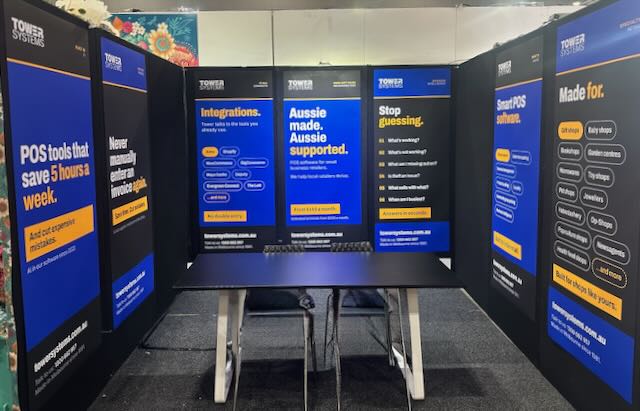
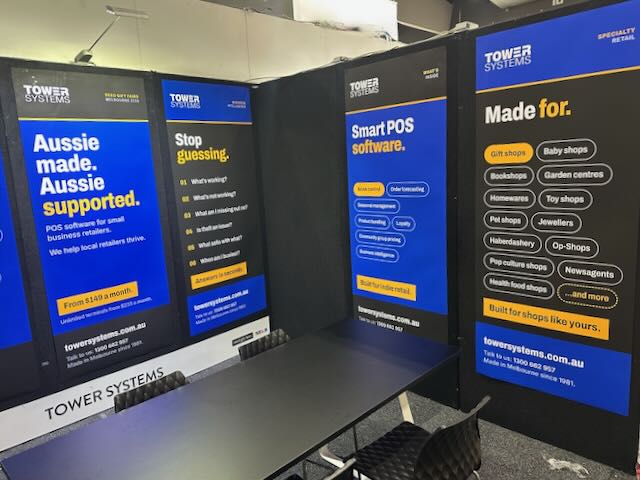
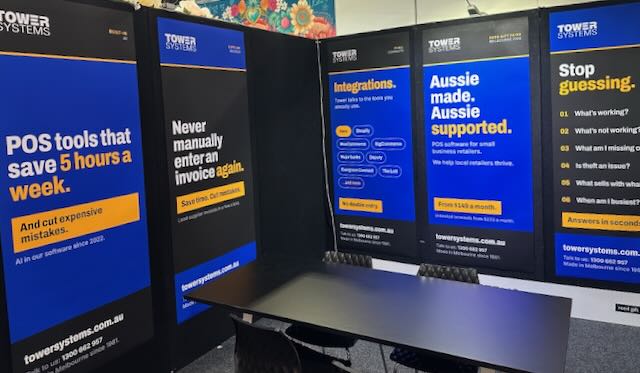
On our stand we will be demonstrating the very latest in POS software for gift shops, jewellers, garden centres, newsagents, toy shops, music shops, bookshops and more.
This is smart POS software. Melbourne made. Melbourne supported.
Gift retail has its own rhythm. Seasonal buying, one-off suppliers, products that need good photos and descriptions to sell online. Our software is built for that. Supplier invoices load in around 30 seconds. AI writes product descriptions and SEO content for you. Reports come with plain advice on what to do next. It connects with Shopify, BigCommerce, WooCommerce and Xero, so your shop floor and your online store stay in step.
If you are walking the fair with buying on your mind, five minutes at our stand could save you hours every week back at the shop. Bring your questions. We like the hard ones.
What sets us apart we think is the help behind the software. Our help desk is in Australia, staffed by people who know retail, and training is part of the deal rather than an extra. When you call, you speak with someone who understands what a busy Saturday in a gift shop looks like. Plenty of the retailers on our software came to us from bigger-name systems where they felt like an account number.
AI is doing real work in our software, and it has been since 2022. We call it Retailer AI, and it draws on Gemini, Claude and ChatGPT inside the POS software itself. A typical business saves between 5 and 8 labour hours a week, worth $175 to $280 at a $35 an hour pay rate. One retailer used it to find more than $10,000 in dead stock. There is plenty of AI hype about at the moment. This is not that. It is invoices loading themselves, reorders drafting themselves and reports that tell you what to do next.
The Melbourne Gift Fair is the best week of the year to see all of this in person. Bring a sales report or a supplier invoice from your own shop if you like, and we will show you what the software does with it on the spot. No script and no canned demo. If you cannot make it to our stand, book a free demo and we will bring the software to you after the fair.
Omnichannel is a jargon word, and we are generally, and rightfully, suspicious of jargon. But behind this one sits something every local retailer needs to think about, so here it is in plain terms.
Omnichannel is critical in retail today to retailers keen to run profitable and growing businesses.
Omnichannel means your shop, your web store, your social media and even your stall at the local market all work as one business. Same stock. Same prices. Same customer, recognised wherever they meet you. A customer might find a product on your website at 10pm, check it is in stock, and collect it from your counter the next morning. To them that is one transaction with one shop. Omnichannel is the word for making it feel that way.
You can’t ignore this. It’s essential in retail today.
Why does it matter to a small local shop? Because your customers already behave this way, whether you are set up for it or not. Most people research online before walking into a physical shop. If someone in your town searches for a product you have on your shelf and finds nothing, the sale often goes to a marketplace or a chain, even though the item was sitting five minutes from their house. You lost a local sale for lack of a shop window that happens to be a screen.
There is a fear that selling online means competing with Amazon on Amazon’s terms. It does not have to. A local shop online has advantages the giants cannot match: collect today rather than a parcel on Thursday, a human who answers the phone, easy returns across the counter, and trust built over years. Online is where you get found. Local is why they choose you.
The hard part of omnichannel for a small retailer has never been the idea, it is the housekeeping. Two systems, two stock records, and suddenly you have sold the last one of something in the shop while the website still shows it as available. That is where POS software earns its keep.
Our Tower Systems POS software connects directly with Shopify, WooCommerce, Magento and BigCommerce. The shop and the web store share the same data, updated as sales happen. Sell the last one at the counter and the website knows. Sell it online and the shop knows. Prices, product details and stock levels live in one place instead of being maintained twice by whoever remembers.
The AI tools in the software carry a lot of the load too. Product descriptions are the reason many shops never get their full range online, because writing hundreds of them is dull work that never reaches the top of the list. The software generates SEO-ready descriptions from your stock data, so the range can actually make it onto the site. And if you sell at markets or community events, the Retailer Roam app takes payments there with the same synchronised stock.
One honest caveat: an online store built on messy stock data will disappoint. If your on-hand figures are unreliable, fix that first, because omnichannel amplifies whatever data you feed it, good or bad.
Done properly, omnichannel does not make your shop less local. It makes your localness visible to people staring at their phones, which these days is everyone.
We are happy to show you how the integrations work, live. Book a demo at towersystems.com.au/pos-software-free-demo.html or call 1300 662 957 (AU), 0800 444 367 (NZ).
We say no to prospective customers more often than you might expect from a software company.
If your business is a franchise, a big chain, or a cafe or restaurant that happens to sell some retail on the side, we are not the right fit and we will tell you so. A bad match costs everyone, us included.
We’re not rude about this, just practical. We know what we are good at, and what we are not made for.
Our software is made for independent, owner-operated specialty retailers in Australia and New Zealand whose trading is more complicated than a generic till can handle. Maybe you run a workshop and need to track repair jobs. Maybe you sell items with serial numbers, or by weight or length, or you carry age-restricted lines, or you want to remember a customer’s anniversary so you can invite them back at the right moment.
A generic POS system scans a barcode and takes a payment. If that is all your shop needs, cheaper options exist and one of them will probably do. It is when the barcode scan is the easy part of the sale that our software makes sense.
We serve 20 specialty retail channels. Jewellers, bike shops, garden centres, newsagents, pet stores, toy shops, fishing and outdoors businesses, produce and farm supply, firearms dealers and more. Each version is built with retailers in that trade, which is where the useful detail comes from. A haberdashery can sell lace by the centimetre. A garden centre prints watering advice on the receipt, which matters in a business where a paper price tag fails the moment it rains. A jeweller tracks a repair from booking to pickup and gets a reminder out ahead of a customer’s anniversary.
Size of business matters less than people assume.
A first-year micro business starts on our Startup tier and an established multistore operator runs unlimited terminals on a higher tier. The common thread among the businesses we serve best is an owner who makes the buying decision and cares personally how the shop runs.
A few things about how we do business, since they come up in almost every sales conversation. We do not take a cut of your sales, on any tier. You choose your own EFTPOS provider. Monthly rental can be cancelled at any time. Our pricing is on our website for anyone to see, and you do not have to hand over an email address or phone number to see it. We find retailers appreciate that more than any feature.
Every call to our help desk is answered by our own people in Australia and New Zealand, and new customers get one-on-one training tailored to their shop. The features in our three major software updates a year come through our software ideas platform, where customers suggest and vote. Nobody buys their way to the top of our roadmap.
We have also been building AI into the software in-house since 2022, before anyone else in Australian specialty retail POS. Retailers use it most for importing supplier invoices from almost any PDF. It also writes product descriptions for web stores and gives plain-English answers about what the sales data is saying. These tools are on our Advanced and Ultimate tiers.
If this sounds like your business, book a demo, online or in your shop, and bring your hard questions. If we are not right for you, we will say so.
Pricing: towersystems.com.au/pricing.html. Book a demo: towersystems.com.au/pos-software-free-demo.html. Or call 1300 662 957 (AU), 0800 444 367 (NZ).
More newsagents have chosen Tower Systems than any other POS software. We didn’t set that label ourselves. Newsagents did, one shop at a time, by choosing us over everything else on offer.
We don’t take that lightly, and we don’t think it happened by accident.
We’re the only POS company in this space that has owned and run its own newsagencies. Our founder bought their first shop in 1996 and built our software off the back of what that business actually needed, not what looked good in a sales pitch. That’s still true of every update we ship, even though our company today does not own a newsagency.
The traditional core of a newsagency, magazines, papers, lottery, is a smaller part of the business than it used to be, and it keeps shrinking. The newsagents doing well are the ones shifting shelf space and attention toward gifts, cards, stationery and collectables. Software built for a magazine-and-lottery counter doesn’t help with that shift. Software built by people who’ve made that shift themselves does.
That’s where features like our loyalty tools earn their keep. You can market to a customer based on what they’ve bought, which means turning a regular lottery shopper into someone who browses the gift wall, or a magazine reader into someone who tries the stationery range. That’s not a feature for its own sake. It’s the whole point of the software.
A newsagency runs on integrations most other retail software doesn’t bother with. We link directly to The Lott through XchangeIT, so lottery sales are captured without manual entry. Magazine arrivals and returns run through XchangeIT too, so your stock and your credits stay accurate without someone doing it by hand. Greeting card suppliers load in as electronic invoices in seconds instead of an afternoon of data entry.
Beyond the newsagency-specific stuff, the software connects to Shopify, Magento and WooCommerce if you sell online, to Xero for your books, and to EFTPOS with every major bank. If you pass on card fees, the system calculates the surcharge for you. We don’t charge a fee per transaction, ever.
The AI tools built into the software write product descriptions for new gift lines, help you compare prices, and turn a stack of sales data into something you can act on, which categories are growing, which need attention, without you having to dig for it.
None of this makes us the biggest software company. It makes us the one most newsagents chose. If you want to see why, we’re happy to show you.
Book a free demo, or call 1300 662 957 in Australia and 0800 444 367 in New Zealand.
Our help desk is human, and it’s local: people in Australia and New Zealand, not an offshore call centre reading from a script. That matters because retail is personal, and so is fixing it when something goes wrong.
But even a good help desk can only work as fast as the conversation allows. A lot of what determines how quickly a problem gets solved isn’t the technician, it’s how the call itself goes.
Support calls usually happen while the shop is open, which means a customer at the counter, and the customer always comes first. Fair enough. But every time a call gets put down mid-troubleshooting, the technician loses the thread. Getting back to where you were takes longer than the interruption itself did. A five-minute pause can turn a ten-minute call into thirty.
Nobody’s fault. It’s just what happens when technical support runs into a trading floor.
A few habits make a real difference to how fast a fix comes through:
If you’re short-staffed and it’s not a good time, say that. It costs nothing, it lets us manage the queue properly, and when you do call back, you get someone’s full attention instead of a rushed half-conversation.
None of this is about making things easier for us at your expense. A call that isn’t interrupted gets solved faster. That means less time away from your counter. Everybody’s better off.
That’s the kind of help desk we’re trying to run: local, human, and worth your time.
Recent Comments