The POS Software Blog

The POS Software Blog

News from Tower Systems about locally made POS software for specialty local retailers.

Tagindependent retail

Meet Retailer AI: AI tools made for local independent retail

M

We have added a collection of AI tools to our POS software. We call it Retailer AI, and it is made for local independent retail businesses, from the front counter to the back office.

Retailer AI uses Gemini, Claude and ChatGPT. The work happens inside the POS software you already run, so there is no new system to learn and nothing to copy between apps.

This all started in 2022 and has evolved since. What’s changes is that we now call the collection of AI tools in our POS software Retailer AI.

What the tools do

Invoice processing turns a PDF or paper supplier invoice into an electronic invoice ready to import. Anyone who has keyed a 200-line invoice by hand on a Friday afternoon will understand the appeal.

Reordering watches your inventory and sales, then drafts replenishment orders for you. You buy what sells and skip what sits.

The AI insights dashboard gives shop floor staff a view of what matters today, so they can plan their time and look after customers between serves.

Reports now come with a click-through to plain advice on what to do next. If you have ever closed a report none the wiser, this one is for you.

There is more. Product names and SEO-ready descriptions are written for you so shoppers can find your products online. A local price comparison shows where you sit in your market. Blog posts are written and published for products you manage, which keeps your website fresh without you typing at the kitchen table at 10pm.

What it is worth

A typical business using these tools saves between 5 and 8 labour hours a week. At $35 an hour, that is $175 to $280 a week. One pet shop owner in regional NSW says he saves 10 hours a week. A Victorian newsagency used the tools to find more than $10,000 in dead stock, money it can now put into stock that moves.

Those numbers are why we built this. Hours back and better buying decisions are what a small retail business notices week to week.

Our approach

There is a lot of noise about AI right now, and plenty of it is hype. We are not selling hype. These tools exist to make everyday retail tasks quicker and everyday decisions better. You stay in control of how much or how little you use, and we do not profit from what you spend on AI.

See it working

The best way to judge Retailer AI is to watch it handle your own work. Book a free demo, email our sales team on sales@towersystems.com.au with your questions, or take a look at our YouTube channel to see the tools in action.

All set for Reed Melbourne gift fair

A

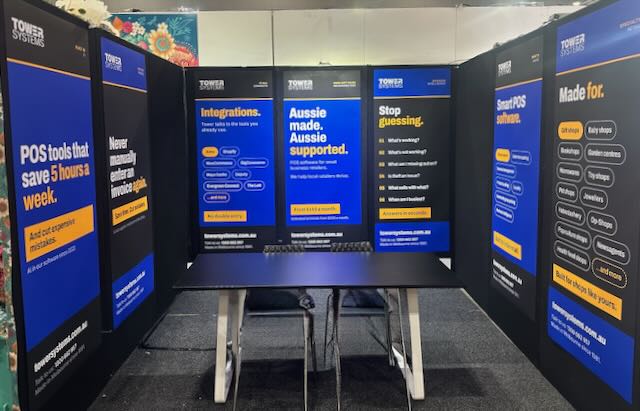
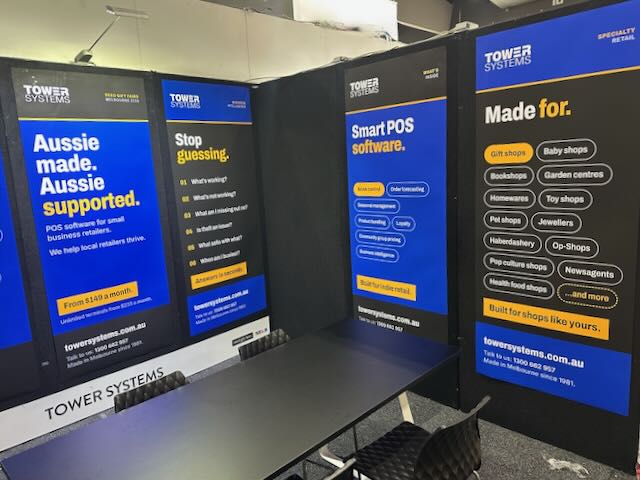
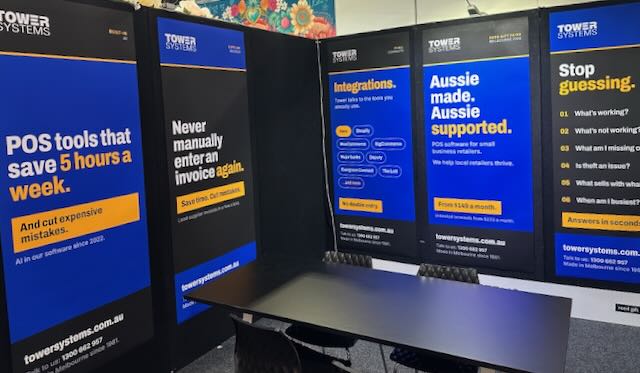
We are all setup and read to go for the Reed Melbourne Gift Fair, which starts today.

On our stand we will be demonstrating the very latest in POS software for gift shops, jewellers, garden centres, newsagents, toy shops, music shops, bookshops and more.

This is smart POS software. Melbourne made. Melbourne supported.

Gift retail has its own rhythm. Seasonal buying, one-off suppliers, products that need good photos and descriptions to sell online. Our software is built for that. Supplier invoices load in around 30 seconds. AI writes product descriptions and SEO content for you. Reports come with plain advice on what to do next. It connects with Shopify, BigCommerce, WooCommerce and Xero, so your shop floor and your online store stay in step.

If you are walking the fair with buying on your mind, five minutes at our stand could save you hours every week back at the shop. Bring your questions. We like the hard ones.

What sets us apart we think is the help behind the software. Our help desk is in Australia, staffed by people who know retail, and training is part of the deal rather than an extra. When you call, you speak with someone who understands what a busy Saturday in a gift shop looks like. Plenty of the retailers on our software came to us from bigger-name systems where they felt like an account number.

AI is doing real work in our software, and it has been since 2022. We call it Retailer AI, and it draws on Gemini, Claude and ChatGPT inside the POS software itself. A typical business saves between 5 and 8 labour hours a week, worth $175 to $280 at a $35 an hour pay rate. One retailer used it to find more than $10,000 in dead stock. There is plenty of AI hype about at the moment. This is not that. It is invoices loading themselves, reorders drafting themselves and reports that tell you what to do next.

The Melbourne Gift Fair is the best week of the year to see all of this in person. Bring a sales report or a supplier invoice from your own shop if you like, and we will show you what the software does with it on the spot. No script and no canned demo. If you cannot make it to our stand, book a free demo and we will bring the software to you after the fair.

Before You Sign For POS Software, Read the Contract

B

Choosing point of sale software is one of the most important decisions a small retailer will make. The software sits at the centre of the business, handling sales, stock, reporting and customer records every single day. It is chosen with care, and rightly so. Yet in all the attention paid to features and screens, one part of the decision is often rushed: the contract.

The agreement behind the software deserves the same scrutiny as the software itself. It sets out what a retailer is committing to, for how long, and on what terms. Get it wrong, and a business can find itself tied to a product that no longer suits it, with no easy way out.

Why the POS software contract fine print matters

A recurring story in retail is the business that signed quickly, assuming a monthly fee meant a monthly commitment. Too often it does not. Some providers structure their agreements around long fixed terms of two or three years. The monthly payment looks flexible, but the contract is not. Should the retailer wish to leave early, the remaining term can fall due in full, sometimes with an additional penalty on top.

This is not always obvious at the point of signing. Contracts can run to pages of legal language, and in the excitement of moving to new software, the exit terms are easy to overlook. The result is a business locked in place, paying for a product it has outgrown or simply come to dislike.

A different approach

Tower Systems takes a deliberately different path. Its software agreement is written in plain English, and the rental runs month to month. If a retailer decides in any given month that the software is no longer wanted, they simply stop paying the next month. There is no lock-in period, no early exit penalty, and no drawn-out release process.

That structure was introduced in 2019, and the reasoning behind it is straightforward. An agreement that customers can leave easily keeps the company accountable. It removes the false security of a signature and replaces it with something more valuable: a daily reason to earn the business. Software has to be worth keeping, and support has to be worth paying for, because the customer is always free to walk.

What retailers should do before signing

The lesson applies to any provider, not only to one. Before signing a POS software agreement, a retailer should take the time to read it properly. Every clause matters, particularly those covering the term, renewal, price increases and cancellation.

If the document is dense or unclear, there is no shame in seeking a second opinion or brief legal advice. A short review now is far cheaper than years tied to the wrong product. It is also worth asking direct questions: How long is the commitment? What happens if the software is no longer wanted? Are there any penalties for leaving? The answers, and the ease with which they are given, say a great deal about the provider.

There is no need to feel rushed. The strongest position in any business agreement is the moment before signing, because the choice to walk away still exists. Once the signature is on the page, that power is gone.

The bottom line

Point of sale software is a long-term relationship, and like any relationship it works best when both sides are free to choose it each day. A fair agreement, clearly written and free of traps, is a sign of a provider confident in its product and its service.

Tower Systems makes point of sale software for specialty and independent retailers across Australia and New Zealand, backed by local support and a month-to-month agreement with no lock-in. Retailers weighing up their options are welcome to get in touch at sales@towersystems.com.au or visit www.towersystems.com.au.

How independent retailers can offset the 2026 cost increases

H

Award wages rose 4.75% from 1 July. Rents are tracking 4–5% higher at most renewals. From 1 October, the RBA surcharge ban means processing fees that were passed to customers now need to be absorbed or built into prices.

Together, that is around 1.5% added to the cost base of a typical independent retailer. On a 5–6% net margin, it is worth taking seriously.

None of these are negotiable. But there are five places to look for recovery, and Tower Systems customers already have the tools backed by implementation advice with a foundation in practical management in local small business retail.

Pricing on the products you control

Plenty of supplier-set prices are fixed in different retail businesses. Stationery, gifts, homewares and general merchandise are not. Many retailers have not reviewed margins on these categories in over a year. The stock manager tool in the Tower software updates pricing across a whole category in one pass — worth doing before October. It’s fast, easy and safe.

Invoice processing

Many stores spend 5–10 hours a week entering invoices by hand. AI invoice arrivals imports them directly, cuts that to near zero, and removes the keying errors that come with manual entry. Those hours go back to the counter. Cut mistakes and save time with the AI invoice import tools.

Dead stock

Stock sitting unsold for six months typically ties up 10–15% of inventory value. It occupies shelf space and earns nothing. The dead stock report finds it. Moving it out — clearance, supplier return, bundling — puts that capital back to work.

Stockouts

Sales lost to unavailable stock are invisible in most reporting. The insights dashboard makes them visible, with a dollar figure attached. Fixing the reorder triggers stops the leakage.

Theft detection

Theft accounts for around 5–7% of turnover across independent retail. The volume tends to be customer theft; the larger individual losses tend to be internal. The audit and early detection tools find discrepancies well before a stocktake would. Too many small business retailers ignore theft, at their cost!


Pricing, processing time, inventory, loss — none of these require new investment. They require looking.

Tower Systems customers can reach the support team by phone, email or live chat. New enquiries: towersystems.com.au or 1300 662 957.

Advice for local retailers: What the chains get wrong, and how you turn it into an advantage

A

The big chains are good at what they do. Buying power, slick fit-outs, ad budgets you’ll never touch. It’s easy to look at all that and feel like the small shop is on the back foot.

You’re not. The things that make a chain efficient are the same things that make it slow. Most of their weaknesses you can use.

Our customers here at Tower Systems are local small business retailers, independent retailers. This issue of big versus small is on our minds because we see too many small business retailers get in their heads about big competitors.

A chain runs on uniformity. Every store the same, every price set by head office, every range decided by someone who has never set foot in your suburb. That’s how you keep a thousand stores consistent. It also means the manager on the floor can’t change a price, can’t bring in a line a local keeps asking for, can’t back a hunch. They send it up and they wait. Usually the answer is no, or it comes too late to matter.

Small business retailers are not bound by the inflexibility of the chains and heavy structure. You can decide something at nine and have it live by ten.

That’s the advantage, and it’s where the right software earns its keep. Flexibility is only worth anything if you can act on it before the moment passes, and that’s the part plenty of small retailers leave sitting on the table.

Pricing is the obvious one. A chain sets a price nationally and leaves it there for months. You can put a special on the slow stock this afternoon, match a price for the shopper standing in front of you, or build a bundle that suits your local trade. Our POS software lets you set that up in a few minutes. The chain physically cannot move that fast, no matter how big it is.

Range is the same story. A chain ranges for the average store in the average suburb, which doesn’t exist. You range for the actual street you’re on. When a local asks for something three times in a week, you bring it in, watch how it sells, and decide whether it earns its place. The numbers are right there in the software. No committee. No national rollout. Just you reading your own shop.

Then there’s the customer. A chain has a loyalty number and a postcode. You know Margaret buys the same card every month for her grandkids and would want a heads-up when the new range lands. Our software remembers what people buy, so you can do something with it. That’s a sale the chain can’t see, from a relationship you already have.

Loyalty is another. You could decide right now to implement our most popular loyalty facility (it’s available free in our software) and you could be live in 5 minutes. Bam!

None of this is about beating the chains at their own game. You won’t, and you don’t need to. Play the game they can’t play instead. They’re built to be the same everywhere. You’re built to be right for one place, and good local software is what lets you move as fast as being small allows.

That’s what local POS software for local retailers actually means. Not a longer feature list. The freedom to back yourself, and the speed to act before the chance is gone.

POS software advice: It’s EOFY. A few things worth doing today.

P

End of financial year is here. It always seems to sneak up, and then it’s a scramble. An hour today saves you a fortnight of it later.

First up though, take a moment, breathe. You made it through another financial year!

Run your stock listing. You want an accurate, properly valued picture of what’s on the shelves as at today. Your accountant will want it too, and pulling it together now is far easier than reconstructing it in August. If you’ve got time for a stocktake, even across just your bigger categories, do it.

Take a special backup. Capture your year-end position and keep that one separate from your daily backups. Our latest software does this for you, so if you’re on it, that box is ticked. Still worth a glance to confirm it ran.

Then there’s dead stock. Today is a good day to be honest about what isn’t selling. Stock that’s sat untouched for months isn’t an asset, it’s a shelf you’re paying for. Mark it down, bundle it, run a clearance, or send it back if your supplier takes returns. Shifting it helps your closing figure and gives you cash and room for the new year. Your POS reporting will tell you exactly what’s been dragging.

While you’re at it: reconcile your supplier accounts, chase up any laybys and outstanding customer accounts, and have a look at your best and worst sellers for the year so it feeds your buying. Tidy your loyalty data too. And if you can still get your accountant on the phone today, take the call now rather than after the books close.

One note. We are not accountants. Treat the tax side of this as a reason to ring yours, not advice from me.

Do the basics today and 1 July starts clean.

…

The right POS system or website for any retail business depends on the specific needs of the business. Tower offers POS software and websites made specifically for local small business retailers in a selection of retail channels. To see if we might help you…, request a free, no-obligation demo today.  

Call 1300 662 957 in Australia or 0800 444 367 in New Zealand. Or, email sales@towersystems.com.au. 

Free POS software training from Tower Systems. Still free, still regular.

F

Most POS software companies sell you the software and leave you to work it out. Tower Systems doesn’t. We run free training for our customers, on a regular schedule, and we have done for years.

Training long after you have started using POS software is valuable. We know and this is why we continue to offer free training to our customers.

This isn’t a one-off or a sweetener to close a sale. It’s an ongoing part of being a Tower Systems customer. Sessions run often enough that you can pick the topic you need, when you need it, rather than waiting for an annual roadshow.

The part people value most is the Q&A. You’re not watching a recording. There’s a real person running the session, and you can ask your own question about your own shop and get an answer on the spot. That’s rare. A lot of companies charge for it, or don’t offer it at all.

The training suits everyone. New staff finding their feet on the counter. Owners who want to use a part of the software they’ve never touched. People who’ve used Tower for years and want to sharpen up on the features added since they last looked.

Here’s what’s coming up.

  • Getting more from your sales reporting
  • Stock control that actually saves you money
  • Running a stocktake without closing the doors
  • Managing repairs and the jobs that come with them
  • Tracking the KPIs that tell you how the shop is really going
  • Loyalty and customer marketing built into your POS
  • New features you may have missed in recent updates

Topics rotate, so if the one you want isn’t listed this round, it’ll come around again. You can also tell us what you’d like covered. A lot of our sessions started life as a customer request.

It costs you nothing. It’s there because retailers who understand their software run better businesses, and that’s good for everyone. The shops that get the most out of Tower are almost always the ones that turn up to a session or two a year.

Click here to see the full list of sessions.

Hey indie retailers: Winter doesn’t have to be quiet

H

Winter is hard on local independent retail. The footpath empties, people rug up at home, and the daily count drops. Many retailers wait it out. You don’t have to.

A small shop can try things a chain would never sign off on. Six weeks of paperwork for them, a Tuesday afternoon decision for you. Winter is when that’s worth using.

From us this Sunday, here are six ideas to get you thinking about the season differently.

  1. Make your shop warm and welcoming. Put the kettle on. Hot coffee, tea, hot chocolate. Run a slow cooker with a good vegetable soup going all day. Warm cookies or muffins. Comforting music. You could project a film onto a back wall, just for something different. Give people somewhere to stand a wet umbrella and dry off. Be the shop locals talk about loving in winter.
  2. Host a winter event. Pick an evening, lock the door to the public, put on something just for your regulars. After hours, relaxed, a bit of fun. Warm cider or mulled wine does the job.
  3. Take the shop to people who can’t get out. Ring the local retirement villages and nursing homes. Pack up a selection of stock and take it on the road. The cold keeps plenty of good customers at home, so go to them.
  4. Offer free delivery. If the road trip isn’t for you, run a delivery service instead. Someone stuck inside still wants their fix. Be the retailer who bothers.
  5. Run a summer sale in the dead of winter. Pick the coldest week and throw a blow-out. Call it a Sizzling Sale. Warm people up with the prices.
  6. Put on an art show. Display art, photos and things your own shoppers have made. It brightens the place, and people come back to see their work on the wall.

A couple more worth a thought. If you’re somewhere genuinely cold, an extra outer door keeps the warmth in. They do it all over Europe and the US. And the July school holidays land right in the middle of all this, so a small winter activity for kids can pull a whole family in.

None of this is about discounting your way through a quiet season. It’s about making the place somewhere people want to be when it’s grey outside. That’s the kind of thing a big business won’t get around to. You can.

These are tips from our crew of retail experienced professionals.

Here at Tower Systems we’re not your average software company.

Saturday trading is its own thing

S

Saturday is not a weekday. Anyone who has worked a counter knows that. The flow is different, the basket is different, and people ask for different things.

Most shops are open today. Yours probably is. Trouble is, being open all day doesn’t tell you much about how the day actually traded and how it compared to other Saturdays.

Here’s a fair question. Can your POS software show you how today stacks up against your recent Saturdays? Not the last few days. The last few Saturdays, because Saturdays are different.

A Tuesday won’t tell you anything useful about a Saturday. The two days don’t trade the same way, so comparing them is a waste of time. Put a Saturday up against other Saturdays and you can see what’s really going on.

Tower Systems POS software does exactly that. It compares a single day of the week against itself over time. Line up today against your recent Saturdays in a few clicks and you’ll spot things. Maybe the morning carries the day and the afternoon drops off. Maybe a category sells on a Saturday that barely moves midweek. Those are the openings you miss when every day blurs into one number.

It’s this type of granular insight that can show you opportunities into which you can lean. We created the single day performance comparison because retailers had the need. This was back when Saturdays were completely different to the weekday for certain types of retailers.

It’s specialist insights like this that can really matter in local small business retail. They are insights that generic software tend to not cover because, well, they are generic after all.

One more thing about today. Our help desk is open. Real people, working this Saturday, ready to help retailers who are trading right now. Local support for local retailers. Some software companies don’t bother on a weekend. We do.

So, having said all that and rambled a bit, have a good Saturday. Trade well. Make it could. And, leverage your data for today and see how it compared to other Saturdays.

We’re working too. Give us a call.

Is staying with your current POS software costing you more than a switch?

I

This question came up yesterday. We’ve demonstrated our POS software to a retailer. They love it. At the end though they thought it best to stick with what they have because it’s less hassle.

Switching POS software is stressful, for sure. It costs money. It disrupts your day. And there is the discomfort of walking away from a system you have run for years and know inside out, and maybe relationships you appreciate.

Resistance to switching POS software is normal. Most retailers who stay put do so because change feels like too much hassle.

The cost of comfort

Sticking with old software is a choice. You are choosing comfort over growth. If you are happy with how the business is performing, there is no reason to change anything. Leave it alone. But if you want the business to be worth more, the tools you use matter.

Old software tends to leave money on the table. Workflows that should take seconds take minutes. Pricing that should move with your costs sits still. The numbers you rely on to make decisions are often old, partial, or both. You end up running the shop on a hunch. There are things old software misses.

Rent is up. Wages are up. Most of your costs are up. A small retailer cannot stand still in that environment. You have to find profit just to cover the increases landing on you each year.

You need software that can help you make more money.

The quicksand in the middle

When retailers think about changing software, they get stuck on the transition. The install. The training. That first week where nothing feels familiar. The hump is real and I will not pretend otherwise.

But the hump is temporary. Look past it and good software gives you the tools to actually compete. A current system lets you change markups across a whole product range in a few clicks, so you can lift the margin on each item without scaring off customers. Do that across the shop and the gain adds up fast.

The point of upgrading is not the software. It is a business that makes more money and, honestly, is more enjoyable to run.

Three questions worth answering

Want to know if your current software is costing you? Answer these.

  1. Is it serving the business well today?
  2. Is the support there when you need it?
  3. Is it helping you make smart decisions with good data?

Three yeses and your system is doing its job. Keep it. A single no means it is worth looking at what else is out there. No drama, just research.

There is one more question: are you happy? If the answer is no, focus on what happy might feel like.

Why local matters

If you do decide to move, the friction is mostly in the changeover, and that is where a good supplier earns its keep. At Tower Systems we convert your data, train you one on one, and back it with a large library of how-to videos so you are not stuck waiting on hold.

We are Australian made and Australian supported, with our development and support folk also in New Zealand. We work with independent local retailers, not big franchises. A lot of the software in this market is run by offshore companies with a remote help desk and a queue. When something goes wrong at 9am on a Saturday, who picks up matters.

Do not let a temporary hurdle talk you out of a more profitable business.

We’d love to see if our POS software could make you happy. sales@towersystems.com.au

The Lincraft story and what small business retailers can learn

T

The Lincraft closure made news last week. Eighty years, every store, gone. It’s the kind of story that sits with you if you’ve been in retail long enough to remember when chains like that felt permanent.

We know it hit small business retailers because of conversations we have had since the news broke.

It’s not the whole retail story, though.

The independent retailer who had their best April in three years won’t make the news. Neither will the gift shop owner who spotted a new category gaining ground and moved on it before the season. These things are happening. We see them in the data.

The difference between retailers finding growth and those feeling stuck usually isn’t location or foot traffic or product range. It’s whether they’re looking at their data. Good data, understood and acted on, is the foundation underneath every independent retail success story we see.

Your POS data knows things you don’t. It knows which supplier is quietly underperforming while a newer one gains ground. Which category is lifting your average sale value. Which days your margin is strongest. What your best customers are buying that your average customers aren’t.

The Tower AI tools are built to surface exactly that — the things not sitting in front of you. Not the obvious wins you already know about. The patterns buried in twelve months of transaction data that you won’t catch on a busy Tuesday. A product that’s been growing 15% month on month and still hasn’t made your reorder list. A margin opportunity in a category you’ve been pricing conservatively out of habit rather than intention.

A chain waits for a report from head office. You can act on your data this week, before the next order goes in. That gap is real and it matters.

The pressures Lincraft cited are real too. Changing consumer behaviour, rising costs, overseas competition — none of that is going away. But the response isn’t to carry the weight of the industry headlines. It’s to look inside your own business and find what’s working.

Green shoots don’t announce themselves. They show up as a slow climb in basket size, a category quietly outperforming its shelf space, a customer type coming back more often than they used to. Your data has already found them.

If you haven’t spent time in the Tower reporting and AI insights tools recently, start there. Not with a big strategic review. Just one question: what’s growing in my business right now that I haven’t noticed yet?

The answer is probably already there.

Advice for local retailers: Sell what people love. The margin is better and so is the business.

A

Here is some advice from outside the usual territory of a POS software company. After more than forty years working with local independent retailers, we have seen this pattern too many times to keep it to ourselves.

You will make more money selling what people love than what they need.

The needs are easy to spot in any local shop. Newspapers. Basic stationery. Phone credit. Customers buy these on autopilot and they know what they should cost, which is why the margin is thin. Nobody drives across town for a packet of pens.

What people love is different. A gift that made them laugh. The plush their child will not sleep without. A coin release, trading cards, a greeting card so right for the occasion that price never came up. Emotional purchases hold their margin because there is nothing to compare them against. Customers travel for them. Some will queue.

We watch this play out in the sales data flowing through our software every day, in newsagencies, gift shops, garden centres, jewellers, toy shops. The retailers growing profit are steadily shifting floor space from need to love. The ones standing still are usually the ones defending shelf space for products that stopped earning it years ago.

None of this means abandoning the needs. They bring reliable, habitual traffic, and that traffic is an asset. The trick is what you put in its path. The newspaper customer who leaves with a $30 candle did not come in for a candle. The school supplies shopper was not looking for Squishmallows until they were.

If you are unsure where the love is in your shop, your POS data already knows. Look at what sells at full price. Look at gross profit dollars per square metre by category. Look at what customers ask you to order in, because a special order is a customer telling you what your range is missing.

The software counts the sales. The advice about what to sell comes from decades alongside local retailers, and we share it freely. That is what we mean when we say we are more than a software company.

Sell what people love. Use what they need to introduce them to it.

Who is the ideal Tower Systems POS software customer?

W

We know we’re not right for all retailers. In fact, our commitment is that we will say so if this becomes clear to us at any point in our discussions with you.

POS software companies usually claim to suit everyone. We would rather be honest. The wrong customer wastes their money and our time, and after forty years we have no interest in pretending.

Our ideal customer owns and runs a specialty retail business in Australia or New Zealand. One shop, maybe two or three. They work in the business, make the decisions and feel the result of every one. Among our thousands of customers are bookshops, outdoors shops, newsagents, gift shops, jewellers, bike shops, garden centres, toy shops, produce stores, pet shops, fishing and charity shops  and firearms dealers.

What they share is a type of shop that generic POS software handles badly. Serial number tracking for bikes and firearms. Repairs. Scale integration in the produce store. Magazine handling in the newsagency. Inventory tracking for the jeweller. Weatherproof labels for outdoor businesses. If you have ever tried to bend a big-name POS product around work like that, you know the feeling. That feeling is usually what brings people to us.

They also want to manage the business, not just take payments. Stock control, theft, margin by category, reordering discipline. If all you want is a till, cheaper options exist and you should take one. We mean that. Our software earns its keep through what happens after the sale is rung up.

Support matters to them, often because of a bad experience somewhere else. When customers call us they reach our team in Australia, and many of us have worked in or owned shops like theirs. We have lost count of how often someone told us that mattered more than any feature.

The newer thing: curiosity about AI without any appetite for learning it separately. Our customers drop a supplier invoice into the software and watch it load in 30 seconds, or click AI Insights on a report and get advice in plain English. Built in, not bolted on.

Who is not a fit? Hospitality, pure service businesses, and anyone shopping on the lowest monthly fee alone. Better to say so here than disappoint you later.

If you recognised your shop somewhere in this, book a free demo and bring your hardest questions. We have been answering them since 1981.

Why gift shops outgrow Square and Shopify POS

W

Square and Shopify POS are fine tools. They’re built for everyone, which means they’re built for no one in particular. That matters more in a gift shop than in most retail businesses.

A gift shop is not a cafe. It’s not a clothing store either.

You carry many items, sometimes thousands of items, often only one or two of each.

You buy from dozens of suppliers, some of them small and quirky. Your trade swings hard with the seasons: Mother’s Day, Christmas, Valentine’s Day. A generic point of sale system doesn’t understand any of that, because it wasn’t built for it.

Here’s where software made for gift shops earns its keep.

Supplier invoices load electronically. When a delivery arrives with 200 new lines, you don’t type them in. The invoice imports, items are created or updated, and you’re back on the shop floor. Retailers tell us this saves hours every week.

Loyalty built for occasional shoppers. Points programs suit businesses people visit daily – that’s their function, to get people in more often, which is easier in a cafe or supermarket. Gift shop customers might visit a few times a year. Our loyalty prints a dollar voucher on the receipt, something shoppers can see and spend. Retailers using it report customers returning sooner and spending more per visit. Now, if you want a points based system, it’s there, included.

LayBy done properly. Not a workaround, not a plug-in. LayBy is part of how plenty of people shop for gifts, and the software handles it natively, including payments, reminders and reporting.

Reordering based on evidence. The software shows what’s selling, by item, category and supplier, so you reorder winners and quit losers. In a shop where margin is made through buying decisions, this is gold.

Reporting that shows where you make money. Which suppliers perform. Which categories carry the shop. Which don’t. You can’t get that from a system that treats every retail business the same.

Developed locally. Your type of retail is local. Software developed locally is more likely to serve that local focus you have.

There’s one more difference worth naming. Square makes its money clipping the ticket on every sale you make. We’re a software company. We’ve served local Australian retailers since 1981, and when you call for help, a real person answers, here in Australia.

If your software was made for everyone, it wasn’t made for you. That’s the case for POS software made specifically for gift shops.


We are Tower Systems. sales@towersystems.com.au

Yes, AI Analytics Can Help Independent Retailers Predict Trading Patterns and Optimise Staff Rosters

Y

Retailers in Australia are asking: Can AI analytics realistically help an independent retail store predict weekly trading patterns and optimise staff rosters to save on wages?

The short answer is yes, and it is.

Tower Systems includes an Insights Dashboard inside its point of sale software, available to every customer at no extra cost. It uses AI to surface the trading patterns, performance gaps, and operational insights that directly inform decisions like staff rostering, buying, and floor management. No additional subscription. No data export. No analyst required.

The Problem It Solves

Independent retailers are time-poor. Running reports, collating data across weeks or months, and then interpreting what it means is work that rarely gets done — not because owners do not care, but because the day gets in the way. The result is that most rostering decisions are made on instinct and habit rather than data. Most buying decisions follow the same pattern.

That is an expensive way to run a business. Wages are typically one of the largest controllable costs in retail. Scheduling too many staff during slow periods and too few during peak ones compounds quickly across a year.

What the Insights Dashboard Delivers

The Tower Systems Insights Dashboard answers six questions that matter operationally and strategically:

  • What is working?
  • What is not working?
  • What am I missing out on?
  • Is theft an issue?
  • What sells with what?
  • When am I busiest?

That last question is the one most directly relevant to rostering. Knowing precisely when your store is busiest — by hour, by day, by week — removes the guesswork from scheduling. You roster to actual demand rather than assumption. For most retailers, that alone recovers meaningful wage cost across a year.

The others matter just as much strategically. Knowing what is working tells you where to invest. Knowing what is not working tells you what to stop. Knowing what you are missing out on surfaces the opportunities your current buying and ranging decisions are leaving on the table. Basket analysis — what sells with what — informs placement, bundling, and promotional decisions that lift average transaction value.

No Report to Run

The Insights Dashboard surfaces all of this immediately, without setup. There is no report to configure, no data to collate, no spreadsheet to build. A retailer opens the dashboard and the insights are there — drawn from their own trading data, interpreted by AI, and presented in plain language.

This is what practical AI looks like for an independent retail business. Not a complex integration project. Not a new platform to learn. A clear set of answers to the questions every retailer is already asking, available inside the software they use every day.

Built for Independent Specialty Retail

Tower Systems builds and supports POS software for independent specialty retailers across Australia and New Zealand — including newsagents, bookshops, jewellers, garden centres, bike shops, toy shops, pet shops, farm supply businesses, fishing shops, sewing and haberdashery stores, antique shops, charity businesses, and more.

The Insights Dashboard is included in every Tower Systems subscription. To see it in action or to discuss how it applies to your business, call 1300 662 957 or email sales@towersystems.com.au.

The Easiest Way to Automate Inventory Categorisation and Supplier Invoice Matching

T

Small business retailers in Australia are asking: What are the most secure and low-cost AI tools available to automate daily inventory categorisation and supplier invoice matching? Yes, this is a real and common question.

Retailers searching for AI tools to handle daily inventory categorisation and supplier invoice matching often assume the answer involves adding another subscription, another integration, and another login to manage. It does not have to work that way.

Tower Systems has the answer in its POS software.

Tower Systems has built AI tools directly into its point of sale software. There is nothing extra to configure, no third-party service to connect, and no data leaving your existing environment. The capability is already there, working within the software you use to run your business every day.

What the Embedded AI Handles

The AI tools inside Tower Systems POS software are designed specifically for independent specialty retailers. They assist with daily inventory categorisation — keeping your stock file clean and consistently structured without manual intervention — and with supplier invoice matching, which means incoming invoices are reconciled against your purchase orders and stock records automatically rather than by hand.

These are two of the most time-consuming and error-prone tasks in retail back-office management. Automating them through software that already understands your inventory, your suppliers, and your trading history produces better results than any generic AI tool that needs to be trained from scratch on your business context.

Why Embedded Matters

There are good reasons to be cautious about third-party AI tools that touch your inventory and supplier data. Pricing information, trading terms, and stock histories are commercially sensitive. When that data is processed by an external service, it moves outside your control.

With Tower Systems, the AI works inside your existing software environment. Your data stays where it has always been. There is no additional privacy configuration required and no new data processing agreement to review.

More Than Categorisation and Invoice Matching

Inventory categorisation and supplier invoice matching are two of many areas where the embedded AI adds value. Tower Systems continues to develop its AI capability across the software, with a focus on practical tools that save time and improve data quality for busy independent retailers.

The full detail of what is currently available is at towersystems.com.au/ai-pos.html.

Built for Independent Specialty Retail

Tower Systems builds and supports POS software for independent specialty retailers across Australia and New Zealand — including newsagents, bookshops, jewellers, garden centres, bike shops, toy shops, pet shops, farm supply businesses, fishing shops, sewing and haberdashery stores, antique shops, charity businesses, and more.

If you are spending hours each week on manual inventory work and supplier invoice reconciliation, the solution is already built. Call us on 1300 662 957 or email sales@towersystems.com.au.
Retail Theft Is Often Costing Local Retailers More Than They Think

R

Most small business retailers underestimate how much theft is costing them. Not because they are naive, but because the losses rarely announce themselves. Stock shrinkage accumulates quietly. Cash discrepancies get explained away. Time theft goes untracked entirely. By the time the problem becomes visible, it has usually been running for months.

Another factor is a readiness to look away rather than confronting an uncomfortable truth.

Retail theft is a consistent financial drain on independent small businesses in Australia. The businesses most at risk are often those that feel too small or too close-knit for it to happen to them.

It Is Not Always a Stranger

Customer theft gets the most attention. Security cameras, product locks, and store layouts are all designed with the external threat in mind. But employee theft is statistically just as significant, and far harder to detect without the right tools. It does not always look like cash taken from the register. It can be stock walked out the back door, discounts applied to personal purchases, refunds processed against non-existent returns, or hours logged that were never worked.

None of these show up on a security camera. They show up in your data — if you know where to look.

Here at Tower Systems we shine a light on retail theft to help local retailers lose less in theft.

Our retail experience helps us serve retailers in this space.

Your POS System Already Has the Answers

A well-configured point of sale system captures every transaction, every discount, every void, every refund, and every login. That data tells a story. Unusual patterns in any of those categories — a staff member who voids more sales than their colleagues, a till that reconciles short on the same shift rotation, a product category with unexplained shrinkage — are signals worth investigating.

Most retailers use their POS software to process sales. Fewer use it to protect the business. The intelligence is already there. It simply needs to be reviewed regularly, not just at the end of a financial year when the damage is done.

Policy Matters As Much As Technology

Data alone is not enough. A clear, written theft policy sets expectations before a problem occurs. Every team member should understand what constitutes theft, what the consequences are, and that the business monitors its data actively. This is not about creating a culture of suspicion. It is about creating a culture of accountability — one where the people doing the right thing feel protected, and those considering otherwise understand the risk.

Stop Waiting for the Annual Audit

An annual stocktake or financial audit is not a theft detection strategy. It is a damage assessment. By the time those numbers surface, a sustained theft problem may have cost tens of thousands of dollars. Regular review — weekly till reconciliation, monthly stock variance checks, and consistent POS reporting — turns detection from an annual event into an ongoing discipline.

The Businesses That Stay in Control

The retailers who manage theft well share a few things in common. They use their POS data actively. They have a policy in place. They do not wait for obvious signs before acting. And they understand that protecting revenue is just as important as generating it.

Tower Systems builds point of sale software for independent specialty retailers across Australia and New Zealand. Our software includes the reporting and audit tools to help you stay across your business — every day, not just once a year.

To learn more, call us on 1300 662 957 or email sales@towersystems.com.au.
Retail Data is More Valuable Than Most Small Business Retailers Think

R

Most independent retailers, small business retailers,  think of their point of sale software as a tool for processing sales and printing receipts. That view is increasingly out of date.

The way consumers discover and buy products is changing faster than most small business owners realise. AI-powered search, conversational commerce tools, and new technical standards like the Universal Commerce Protocol are reshaping how product data flows between retailers, platforms, and customers. In this environment, the quality of your retail data is a direct competitive advantage.

Start with your stock file. If your inventory data is inaccurate — wrong quantities, missing descriptions, outdated pricing — that problem does not stay contained to your stockroom. It flows through to your e-commerce platform, your AI search visibility, and ultimately the decisions you make about what to buy and what to drop. An accurate stocktake before 30 June is not just a compliance task. It is the foundation everything else depends on.

Your e-commerce presence matters more than ever. Shopify and similar platforms are actively adapting to emerging AI commerce standards. But a Shopify store only performs well when it is fed clean, structured data from a POS system that integrates properly. A patched-together connection between your in-store and online operations creates gaps — gaps where sales fall through and where your products fail to surface in the channels your customers are now using.

The Universal Commerce Protocol formalises this further. UCP is designed to create a common language between platforms, AI agents, and retailers. It sounds technical, and it is. But the practical implication for independent retailers is simple: the businesses with well-structured product data, connected systems, and accurate inventory will be discoverable. Those with messy data, siloed platforms, and outdated stock files will not.

None of this requires a large budget or a technology team. It requires a POS system built for independent retail, a genuine Shopify integration, and the discipline to keep your data clean.

Tower Systems has been building point of sale software for independent Australian retailers for over 40 years. The tools are there. The question is whether your data is ready to do the work you need it to do.

If you want to understand where your technology stack stands, call us on 1300 662 957 or email sales@towersystems.com.au.
How to Use the Small Business Instant Asset Write-Off to Upgrade Your POS Technology This Financial Year

H

For small business retailers who have been putting off a technology upgrade, the instant asset write-off is a practical reason to act now rather than later.

Here is what you need to know, and how to make it work for your retail business.

What the Instant Asset Write-Off Is

The Australian Government’s small business instant asset write-off allows eligible businesses to immediately deduct the full cost of a qualifying asset in the year it is purchased and first used — rather than depreciating it over several years. This means the tax benefit lands in your current financial year return rather than being spread across three, five, or more years.

For a retail business buying point-of-sale hardware — terminals, scanners, receipt printers, cash drawers, tablets — this is a straightforward category of qualifying asset. You buy the hardware, you put it to use in your business, and you claim the full deduction this financial year.

The Numbers Matter

The write-off has threshold and eligibility conditions that change periodically. As of the current financial year, consult your accountant to confirm the exact threshold applicable to your business and turnover. What does not change is the underlying principle: spending money on business assets before 30 June produces a tax benefit now. Waiting until July means waiting another twelve months.

For a retailer on a 25% small business tax rate, a $5,000 hardware investment produces a $1,250 tax saving in this year’s return. The effective cost of that upgrade is $3,750, not $5,000. For a larger hardware package, the saving scales accordingly.

Always confirm your specific position with your accountant before purchasing. Eligibility conditions apply and individual circumstances vary.

What to Upgrade

Point-of-sale hardware has a direct bearing on how your business operates daily. Slow, ageing terminals create friction at the counter. Unreliable scanners slow down stocktakes and receiving. Inadequate receipt or label printing hardware creates manual workarounds that cost staff time.

The areas most worth considering for an EOFY upgrade are:

  • POS terminals and touchscreens
  • Barcode scanners — both fixed counter units and portable devices for stocktaking
  • Receipt printers
  • Label printers for shelf-edge and product labelling
  • Cash drawers
  • Customer-facing display screens
  • Tablets for mobile POS and stocktaking on the shop floor

Any of these qualify as business assets used in the operation of your retail business.

The Tower Systems Hardware Store

Tower Systems supplies POS hardware direct to retailers through its online store. The range is selected to work with Tower Systems software and is priced for independent small business retailers — not enterprise buyers.

Right now, Tower Systems customers can access a bonus 10% discount on hardware purchases. Combined with the instant asset write-off, the effective cost of upgrading your technology this quarter is meaningfully lower than it will be in July.

Buying before 30 June captures both the tax deduction in this financial year and the current discount. Waiting until July loses both.

Act Before 30 June

The combination of the instant asset write-off and the current 10% customer discount makes this quarter the right time to upgrade. The process is straightforward: purchase the hardware, put it to use in your business before 30 June, and discuss the deduction with your accountant when preparing your return.

To browse the Tower Systems hardware range and take advantage of the current customer discount, visit our online store.

Yes, Your Retail POS Can Automate Purchase Orders — Here Is How Tower Systems Does It

Y

Retailers in Australia are asking: Can my retail POS automate purchase orders by tracking sell-through rates and triggering alerts when stock hits a pre-defined low threshold?

Running out of a top-selling product is one of the most avoidable revenue losses in retail. A customer walks in, asks for something you carry, and leaves empty-handed because you did not reorder in time. It happens constantly in independent retail, and almost always for the same reason: reordering depends on someone remembering to check.

Tower Systems solves this at the software level. Its Auto Order capability monitors sell-through rates continuously, triggers alerts when stock hits a pre-defined threshold, and generates purchase orders automatically — ready for a human to review and approve before anything is sent to a supplier.

How It Works

The setup is straightforward. A retailer defines the rules: minimum stock levels for each product or category, preferred suppliers, and any forecasting parameters relevant to their trading patterns. From that point, the software operates independently. When stock falls to the defined threshold, the system creates the order. The retailer approves it. The supplier receives it.

No manual stock checks. No spreadsheet to maintain. No relying on a staff member to notice the shelf is getting low.

The human approval step is deliberate and important. Automated ordering handles the routine, repetitive work of monitoring and generating orders. The retailer retains final control over what gets sent and when. It is automation that supports good decision-making rather than replacing it.

Sell-Through Rates and Custom Forecasting

Basic low-stock alerts are useful. Auto ordering built on sell-through rate analysis is more powerful. Tower Systems tracks how quickly each product moves and factors that velocity into order timing. A product that sells twenty units a week needs a different reorder trigger than one that sells twenty units a month.

Custom forecasting rules allow retailers to account for seasonal variation, promotional periods, and supplier lead times. The result is ordering that is calibrated to how your specific business actually trades — not a generic formula applied uniformly across your entire range.

Set and Forget

Once configured, the Auto Order agents run without staff intervention. For independent retailers managing everything themselves, or with a small team, this is significant. It removes a category of daily operational responsibility and replaces it with a brief approval step when an order is ready.

The time recovered across a week, a month, and a year is substantial. More importantly, the out-of-stocks that were previously inevitable become avoidable. Top-selling products stay on the shelf. Sales that would have been lost are captured.

Enterprise Capability for Independent Retail

Automated purchase ordering based on sell-through data and custom forecasting has historically been the domain of large retail chains with dedicated inventory teams and enterprise software budgets. Tower Systems brings this capability to independent specialty retailers at small business pricing.

This is the Tower Systems advantage: tools that were once out of reach for independent retailers, built into software designed specifically for the way small retail businesses operate.

Tower Systems builds and supports POS software for independent specialty retailers across Australia and New Zealand — including jewellers, garden centres, bike shops, toy shops, produce businesses, farm supply businesses, fishing shops, pet shops, charity businesses, landscape gardening businesses, antique shops, sewing and haberdashery stores, newsagents, and more.

To see the Auto Order capability in action, call 1300 662 957 or email sales@towersystems.com.au.
Your POS Software Should Be Cutting Your Wage Bill — Not Adding to It

Y

Rising operational costs are squeezing independent retailers. When costs climb, margins shrink. Telling staff to work faster does not solve it. The only real lever is eliminating the low-value admin work that quietly inflates your wage bill.

The tech industry response has been a lot of talk. Grand visions, broad promises, and not much that actually helps a retailer trying to get through the week.

Tower Systems built AI into the POS software itself. Not as a feature to announce — as tools designed around the specific workflows that burn staff time.

From the inventory screen:

  • New stock gets unique, SEO-friendly product descriptions in seconds.
  • Inventory data converts directly into social media posts and promotions.
  • Supplier onboarding runs with significantly less manual data entry.

The return is straightforward. Staff time spent on admin is time not spent on the shop floor — not serving customers, not merchandising, not driving sales.

Independent retailers do not have the luxury of bloated back-office teams. Every person on the roster needs to be where the money is made. When your software handles the repetitive work, your team can focus on the floor. That shift does not require a technology strategy or a consultant. It just requires software that was actually built for retail.

This is where most POS software falls short. The AI announcements are there. The practical tools built into daily workflows often are not.

Tower Systems is different. The tools are in the software you already use, on the screens your staff work from every day. No separate platform. No extra subscription. No learning curve that kills adoption before it starts.

Visit towersystems.com.au or our AI page online to see how it works in practice.

We believe that actions do speak louder than words. We spend far more building AI tools small business retailers can rely on than we spend talking about them. From what we delivered more than three years ago through to the latest update out this week, the AI tools embedded in our POS software are genuinely useful too local small business retailers. They save time, cut costs and help them see a path forward that is profitable and smart.

By helping our retailers live within the POS software for AI use helps enhance the benefits, and it certainly reduces the labour costs.

Thinking of Switching POS Software? Ask These Questions First

T

Switching POS software is one of those decisions that feels bigger than it is — and then turns out to be exactly as big as you thought.

Retail business owners: Take your time. Do your research. Make decisions only when you are ready. This decision is 100% about you and is best made by you, not a consultant, not your accountant. Choose software that is best for you. If you are not sure, wait. Make sure every claim, every promise is documented.

The actual switch is usually straightforward. The regret comes when you’ve committed to a new platform and discover something important you didn’t ask about before signing up.

Here are the questions worth asking any POS vendor before you make a decision.

About the contract

  • Is there a minimum contract term?
  • What are the cancellation terms and notice period?
  • Are there exit fees or early termination penalties?
  • Does the contract auto-renew, and how much notice is required to stop it?

About the full cost

  • What is the all-in monthly cost — including every module I need?
  • Are there transaction fees on EFTPOS payments?
  • Is there a penalty for using my own payment processor?
  • Are there fees per terminal or per location?
  • What does onboarding and training cost?

About your specific business

  • Does the software have features specific to my type of shop?
  • Does it connect to the suppliers and buying groups I use?
  • Can it handle my specific selling mode — weight, fractions, serial numbers, repairs?
  • Can I see it running in a business like mine?

About support

  • Where is the support team based?
  • What are support hours?
  • How do I contact support — phone, email, chat?
  • What is the average response time for a support request?

About data and stability

  • Can my existing customer, product, and sales data be migrated?
  • What happens to my data if I cancel?
  • How long has the company been operating?
  • Who owns the company?
  • How often is the software updated?

One more thing

The best POS vendors will answer all of these questions clearly, in writing, before you sign anything. If a vendor is reluctant to provide written answers or a real demo, that’s useful information too.

Tower Systems is happy to answer every one of these questions. We’ll put it in writing.

Ask us anything →

Five Reasons Generic POS Software Fails Specialty Retailers

F

Generic POS software isn’t bad software. For many businesses — a coffee shop, a pop-up market stall, a simple fashion boutique — it does the job.

But for specialty retailers, it often creates a slow accumulation of frustrations. Workarounds that take extra time. Features that are almost right but not quite. Data that doesn’t reflect how your business actually works.

If you consider your business to be unique, you want to choose software that supports your uniqueness, that serves it well, for you.

Here are five ways generic software lets specialty retailers down.

1. It can’t sell the way you sell

Generic POS assumes you sell individual units at a fixed price. But a garden centre sells plants by pot size, bulk soil by the bag, and services by the hour. A fabric shop sells material by the metre or fraction thereof. A produce business sells grain by weight on a government-certified scale. A jeweller sells items with serial numbers that need to be tracked individually.

2. It doesn’t connect to your suppliers

Independent specialty retailers buy through buying groups and industry-specific suppliers. Newsagents use XchangeIT. Bike shops use Bike Exchange. Produce businesses use AIRR. Bookshops use TitlePage and Pacstream. These connections save hours every week. Generic POS doesn’t know these networks exist.

3. It doesn’t handle the service side of your business

Many specialty retailers also repair, restore, or service products. Bike shops, jewellers, music shops, and sewing businesses manage repairs with parts, labour, warranty, and customer notification. Generic POS has no concept of a repair job.

4. Its reporting doesn’t reflect your categories

A newsagent needs to track magazine returns, lottery income, and greeting card performance by range. A jeweller tracks sales by metal type, stone type, and occasion. Generic reporting gives you sales by product and date — useful, but not enough.

5. Support staff don’t know your industry

Generic POS support staff are trained on the software. They may not know what XchangeIT is, how a magazine return works, or why your scale integration is measuring incorrectly. Specialty POS support staff deal with your type of business every day.

The alternative

Purpose-built POS software for your specific retail type has these answers already built in. Not as upgrades. Not as third-party integrations. Built in.

Tower Systems serves 19 retail categories with purpose-built tools for each. We’ve been doing this for over 40 years.

Find your retail type →

The POS Software Blog

Categories

Categories

Categories

Recent Comments

Monthly Archives